Can a Sold TikTok Account Be Recovered by the Seller?
Key data points
- 29% of internet users have now experienced an account takeover, up from 22% a few years earlier— Security.org Account Takeover Annual Report
- A deleted TikTok account stays recoverable for 30 days before it is permanently erased— TikTok Help Center: Deleting an account
- Multi-factor authentication blocks more than 99.9% of automated account-takeover attempts— Microsoft Security, 2019
You pay for an account, the login works, and a few weeks later it’s gone — back with the person who sold it to you. That’s the scenario behind the question, so here it is plainly: can a sold TikTok account be recovered by the original owner? Yes, it can. But recovery isn’t a single event. It’s several separate doors, and a seller only needs one of them left open.
Which doors exist is the part that decides everything. Shut all of them and a clawback goes from easy to nearly impossible. Miss one and the smoothest handover in the world won’t save you.
So can the seller really take it back?
They can, and it usually comes down to whoever still holds a way to reset the account. There are four of them, and they’re worth naming one at a time, because people tend to think about the password and forget the rest.
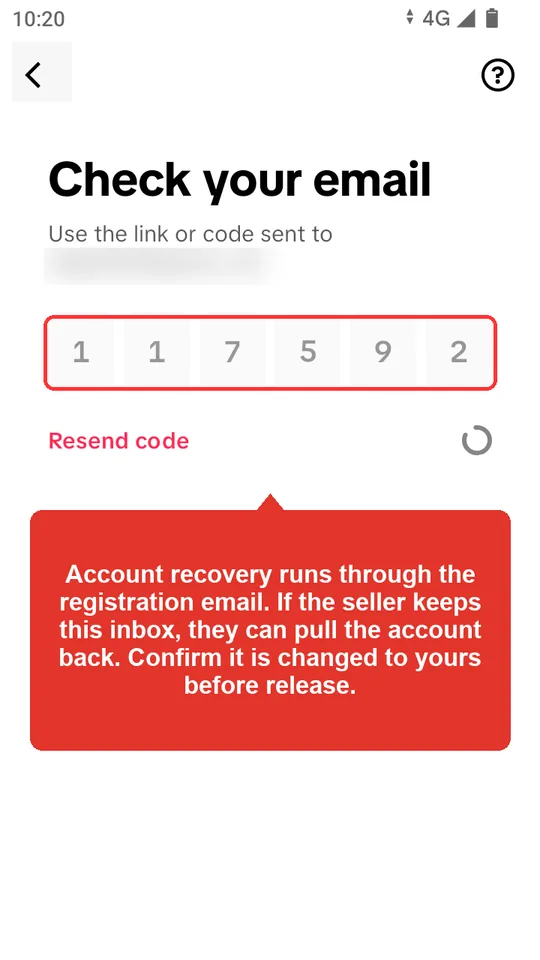
The first two are the recovery email and the phone number on the account — TikTok’s reset keys. As long as either still belongs to the seller, they tap “forgot password,” get a code, and they’re back in; your new password doesn’t even slow them down. The third gets missed the most. If the account has a Google, Facebook, or Apple login linked to it, that login keeps working even after the email and password change, because it’s a separate door entirely. A buyer can do everything right on the password side and leave that one wide open.
Reclaiming a sold account is the same mechanic as any account takeover, with the original owner cast as the attacker — and those aren’t fringe events. Security.org’s account takeover report says 29% of internet users have now experienced one, up from 22% a few years earlier. The seller already knows the recovery details, which is a head start no random hacker gets.
The claim that beats your password
The fourth door is the one that catches careful buyers off guard, because it doesn’t run through any setting you can change. The seller goes to TikTok directly.
Through the in-app Report a problem flow, anyone can file to recover an account they say is theirs. What TikTok asks for isn’t the current password — it’s proof you’re the rightful owner: the account’s creation date, the original email it was opened with, old login screenshots, sometimes early receipts or content. And here’s the uncomfortable part. That trail almost always points at the seller, not you. They opened the account. They have the years of history. You have a few weeks of use and a payment receipt.
So a seller can hand you a fully working account, watch you change the email, phone, and password, wait a couple of weeks, and then quietly file an ownership claim built on a history only they have. If TikTok sees a creation story that matches the claimant, it may well hand the account back. You did everything the guides told you to, and it wasn’t enough, because the platform that holds the master key was never part of your handover.
Report a problem is open to you, too, which is the part worth remembering. If you keep your own evidence of the handover — a screen recording of the seller unlinking their details and reading out the verification codes while you watched — you have something to file back with. It won’t match years of history, but a documented, consensual transfer is a far stronger position than silence.
The 30-day deletion window cuts the other way
There’s a quieter version of a clawback that doesn’t try to take the account back at all. It just destroys it.
When a TikTok account is deleted, it isn’t erased on the spot. TikTok deactivates it and keeps it recoverable for 30 days; logging back in during that window reactivates it, and only after the 30 days is it permanently removed. That cuts both ways. A seller who kept any working login route can delete the account after the money is released, and if they also hold the email or phone, they’re the one who can log back in to undo it — or not. A buyer who controls every login, on the other hand, can reverse a deletion within those 30 days simply by signing in. Either way, the 30 days belong to whoever controls the logins.
Deletion itself isn’t the thing to fixate on. The real point is that “the login works and the seller went quiet” is not the same as “this is settled.” Settled means the recovery paths are confirmed dead and enough time has passed that a reset, a claim, or a deletion would already have happened.
What actually closes the doors
The first three doors you can close yourself, and the order matters: move the recovery email and phone to you first, then change the password, then set up two-factor on your own device, then unlink any Google, Facebook, or Apple login the seller left attached. Do the password first, while the old email is still on file, and you’ve locked a door whose key is still in the seller’s pocket. The full step-by-step — including the catch where TikTok sends verification codes to the seller’s details mid-process, so the seller has to be present — is laid out in the guide on transferring an account to a new owner.
Why bother being this precise about a second factor? Because it’s the single most effective lock there is. Multi-factor authentication blocks more than 99.9% of automated account-takeover attempts — but that protection only ever serves whoever holds the second factor. Leave it on the seller’s phone and that protection is quietly defending them against you. Moving it onto your own device is what flips it from their lock to yours.
What none of this touches is door four. No setting closes an ownership claim, because the claim doesn’t go through the account — it goes around it, straight to TikTok. That’s the gap that lockdown alone can’t fill, and it’s the reason a sold account is never fully safe on credential changes alone. It’s also why running the pre-purchase verification checks before you commit matters as much as the lockdown after — the cleaner the account’s history, the less ammunition a future claim has.
Can they really win it back with a government ID?
This is the version of the fear that sounds the scariest, and it’s worth being precise about. An ID helps a claimant, but it’s rarely the thing that decides it. A lot of accounts were never tied to a verified identity at all, so there’s no ID on file to match against in the first place.
What carries the weight is the account’s history — the same creation date, original email, and early-login trail that powers any ownership claim. An ID is just one more item in that pile, strongest when the account was already verified under the seller’s real name. So the honest answer is that a seller doesn’t need an ID to have a shot at recovery; they need a history, and they almost always have one. Which loops back to the same structural problem: in a private deal, the deck of evidence is stacked toward the person who created the account, and no amount of careful clicking on your end changes that.
Where that leaves a buyer
So the buyer’s job splits in two. The lockdown — email, phone, password, 2FA, linked logins — closes the three doors you can reach. Door four, the ownership claim, stays open no matter how clean your work is, and a cold-DM deal gives you nothing to fall back on if it ever swings. A reclaim like this is one of the scams that target account buyers, and the warning signs tend to show up before you ever pay. For buyers weighing what TikTok’s terms and the law say about transferring accounts — a platform-enforcement risk that stacks on top of this clawback risk — that full picture is worth reading before any deal. Sellers face the mirror image of it, which is why selling an account safely — and following the high-level selling rules — comes down to the same clean handover run in reverse.
Escrow covers a narrower gap: the handover itself. The platform holds the money during delivery and review (on AccountsSale, AccountsSale (Official) is also the seller of every current listing, so it is not a neutral third party). If the seller has not delivered, the buyer can cancel after 12 hours and the order is refunded automatically after 48 hours. Once delivered, if a listed attribute is wrong, the buyer must open a dispute before confirming or before the 72-hour deadline; the money then stays in escrow while an administrator decides whether to refund or release it. Without a dispute, funds release automatically when the 72 hours end, and any refund goes to the AccountsSale wallet balance (wallet withdrawals are currently paused). The details are on the page explaining how the order hold, review window, and release work.
Post-completion recovery is different from ordinary escrow. It is covered only when the individual listing and order explicitly displayed an active Recovery Guarantee and coverage period, the buyer files evidence on time, and an administrator approves the claim. None of the current listings on this site offers one, and listings without it have no post-completion recovery coverage; browse the current TikTok Gifter Badge sale category and check each product’s displayed status before paying.
Frequently Asked Questions
- Can a sold TikTok account be recovered after the buyer changes the password?
- Yes, in two cases. If any recovery path was missed — an old email or phone number that never fully came off — the seller resets straight through it, and the new password falls with it. Even with every reset path closed, they can still file an ownership claim with TikTok support, handing over the account's creation date, old login screenshots, and the original email. A password change locks the door you can see; it does nothing about the claim filed with the platform that holds the master key.
- How long after buying is the account at risk of being clawed back?
- There is no fixed cut-off. Recovery attempts are most common soon after the sale, when a seller can still reset through a missed recovery route or file an ownership claim, but a claim can also come later, because it rests on the account's creation history rather than on current logins. A deleted account also stays recoverable for 30 days, so a spiteful seller can wipe it after cashing out. Closing every reset path early shrinks the risk; it does not end it.
- Can the original owner prove ownership to TikTok with a government ID?
- An ID helps them, but it isn't the deciding factor on its own — plenty of accounts were never tied to a verified identity in the first place. What carries more weight is the account's history: the creation date, the original email, old receipts or screenshots, the first devices it logged in from. That trail almost always points back to the seller, not the buyer, which is exactly why a recovery claim filed weeks after a sale can succeed even when the buyer holds the current password.
- What actually stops a sold TikTok account from being recovered?
- First, close every reset path before completion: recovery email, phone, password, two-factor authentication, and linked logins. Second, check whether the individual listing and order explicitly show an active Recovery Guarantee. Only a timely, administrator-approved claim under that coverage is paid, and no current AccountsSale listing offers one. Without it, a reclaim after release is not covered.