The Safest Way to Pay for a TikTok Account
Key data points
- In 2024, U.S. fraud victims lost $2.09 billion to scams paid by bank transfer — the single highest-loss payment method, ahead of cryptocurrency at $1.42 billion.— Federal Trade Commission, March 2025 (2024 fraud data)
- Losses to scams paid by bank transfer or cryptocurrency in 2024 exceeded the losses from all other payment methods combined.— Federal Trade Commission, March 2025 (2024 fraud data)
- PayPal Friends & Family payments are excluded from PayPal's Purchase Protection, leaving the buyer no recourse if a deal goes wrong.— PayPal Purchase Protection policy
There’s a version of this purchase that’s reasonably safe and a version that loses you everything, and the difference usually comes down to how the money moves. Whether buying a TikTok account is safe at all depends on the seller and the account — but once you’ve decided to go ahead, the payment step is where most people who get burned actually get burned.
Reversibility Is the Whole Game
Most advice about paying for an account argues over brand names — PayPal versus crypto versus a marketplace. That’s the wrong axis. What actually decides whether you lose your money is whether the payment can be undone, and whether anyone is obligated to step in when a deal falls apart.
An account is a digital good with no shipping label, no tracking number, and no physical proof it ever changed hands. That makes it one of the hardest purchases to claw back after the fact. The Federal Trade Commission reported that in 2024, Americans lost more to scams paid by bank transfer and cryptocurrency — $2.09 billion and $1.42 billion respectively — than to all other payment methods combined. Those two top the list for one reason: once the money moves, it’s gone.
Pair an irreversible payment with a seller you’ve never met, operating under a username with no transaction record, and you’ve built the worst combination in account trading. The method you pick is the line between a recoverable mistake and a total loss.
The Methods, From Worst to Safest
Irreversible by Design: Crypto, Wire, and Gift Cards
Cryptocurrency transfers, bank wires, and gift-card codes share one property: once they’re sent, nobody can pull them back. There’s no chargeback button on a blockchain, a completed wire is rarely recalled, and a redeemed gift card is simply gone.
Scammers gravitate to them for that exact reason. A seller who insists on crypto “to avoid fees” or asks for gift cards isn’t saving you money — they’re choosing the one rail where you have zero recourse. The classic version runs on Telegram: you send crypto, the seller confirms receipt, and the account never shows up. There’s no one to appeal to, because there was never any accountability in the deal to begin with.
This doesn’t make crypto inherently fraudulent. Plenty of real marketplaces accept it — AccountsSale takes USDT (TRC-20) only — but inside an order hold with written rules, not as a direct hand-to-hand payment. The danger was never the currency. It’s sending something irreversible straight to a stranger.
PayPal — and the Friends & Family Trap
PayPal feels safe because people associate it with buyer protection. That protection is real, but it applies to only one of PayPal’s two payment types, and sellers in this market know which one to ask for.
Goods & Services payments can be eligible for PayPal’s Purchase Protection, which lets you open an Item Not Received or Significantly Not as Described dispute. That is not a promise of reimbursement: the transaction and item must remain eligible, exclusions still apply, and PayPal decides the claim. Friends & Family payments have none of that protection. PayPal’s own policy excludes personal payments from Purchase Protection — the system treats them as payments to people you know rather than purchases.
So when a seller says “just send it Friends & Family to skip the fee,” what they’re really asking is for you to waive every protection PayPal gives you. That request alone is a red flag. A legitimate seller has no reason to strip away your recourse.
Even Goods & Services has limits with accounts. Because there’s no physical delivery to prove, disputes over intangible items can break either way, and a seller who’s done this before knows how to frame the transaction. G&S beats F&F by a wide margin — but it’s a backstop, not a guarantee.
Credit-Card Chargebacks: Why They Often Fail Here
A lot of buyers treat a credit card as a safety net: if the account turns out to be junk, just call the bank and charge it back. For physical goods that often works. For a TikTok account it frequently doesn’t.
Chargebacks on digital items hit a wall — there’s nothing to prove non-delivery, and the card issuer can rule that you authorized the payment voluntarily. If you knowingly sent money to a person, the bank may decide you got what you paid for, even when “what you paid for” turns out to be stolen or worthless. Worth attempting if a deal goes bad; a mistake to lean on as your plan A.
Escrow: The Only Method Built for Account Trading
Everything above is a consumer payment tool stretched over a transaction it wasn’t designed for. Escrow is the one method built for exactly this.
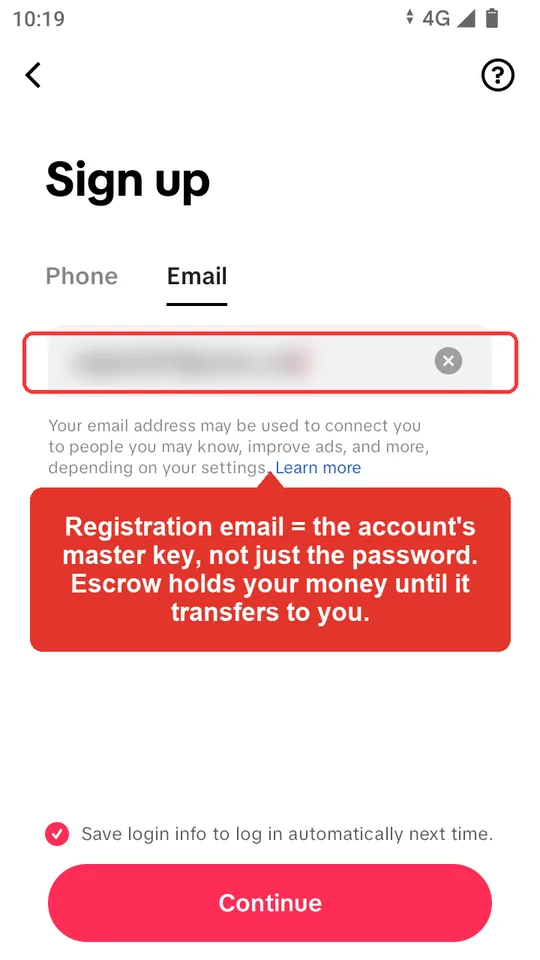
The mechanic is simple: you pay, but the money doesn’t reach the seller. It sits with an intermediary instead. The seller transfers the account — and not just the password, but the registration email, phone number, and 2FA authenticator. You log in, check every item the listing promised, review the analytics, and look for outstanding flags — all inside the review window. On AccountsSale that window is 72 hours after delivery: funds are released when you confirm, or automatically when the window ends without a dispute. If the seller never delivers, you can cancel after 12 hours, and an undelivered order refunds automatically at 48 hours. If the account isn’t what was described, a dispute opened before release keeps the money held while an administrator decides. Refunds land in your AccountsSale wallet balance, and wallet withdrawals are currently paused for all users — so for now a refund is platform balance, not cash back.
One more thing to check is who holds the money. Escrow is only as neutral as the party running it. On AccountsSale, the platform operator, AccountsSale (Official), is also the seller of every current listing, so the hold runs under the platform’s published order rules rather than through an independent third party.
Money held through delivery and review is the one shift that removes the failure mode behind almost every payment scam: paying and getting nothing. Every method above runs into the same conclusion — don’t send an irreversible payment straight to the seller; pay into a hold with written release rules, and finish your checks before that window closes. The details of how AccountsSale holds, releases, and refunds an order are worth reading before you commit to a deal.
”Pay a Deposit First” Is Almost Always a Scam
A common pitch is the upfront deposit: send a deposit now “to show you’re serious,” with the rest due on delivery. Skip it. A deposit paid straight to the seller carries every risk of an irreversible payment with none of escrow’s protection. If they disappear with it, you have the exact problem you were trying to avoid, just for a smaller number.
In a properly structured deal, nothing reaches the seller before delivery and the review window. The funds — all of them — stay in the hold. A seller asking for money to move before delivery is asking you to carry the risk they should be carrying.
Payment Red Flags
Most of these surface before any money moves, if you’re watching:
- Seller wants cryptocurrency sent straight to a personal wallet, with no escrow and no order record.
- “Send it Friends & Family,” or any nudge toward a no-protection payment type.
- Refusal to use an escrow service or marketplace with written release and dispute rules.
- Pressure to pay today — “another buyer’s waiting,” “price goes up tomorrow.”
- A deposit demanded before the account transfers.
- The whole deal living in direct messages with no platform record.
Urgency is the common thread. A seller manufacturing time pressure is almost always trying to push you past the moment you’d stop and think about how you’re paying. The wider playbook these sellers run is worth reading before you message anyone.
What Escrow Still Doesn’t Cover
Escrow protects the transaction. It doesn’t protect what happens after the money is released.
TikTok’s current Terms of Service say not to give another person access to an account or transfer it without TikTok’s permission, and the platform’s recovery tools are built for the original owner, not the buyer. Even after a clean credential handover, a previous owner can sometimes reclaim an account through TikTok’s appeals process. Recovery attempts are most common soon after the sale, but they can happen later, sometimes months later. By then escrow has closed and the funds are long gone to the seller.
Paying through a platform rather than a stranger’s wallet keeps your money out of the seller’s hands during delivery and review. That protection ends at release: recovery by a previous owner after release is covered only if the order shows an active Recovery Guarantee, and no current AccountsSale listing offers one.
Frequently Asked Questions
Is it safe to pay with PayPal for a TikTok account?
Only with Goods & Services, and even then with limits. A G&S transaction may be eligible for PayPal’s Purchase Protection, allowing you to open a dispute, but PayPal can deny claims or exclude transactions and does not guarantee reimbursement. Friends & Family is expressly excluded from Purchase Protection. If a seller insists on F&F, treat it as a reason to walk. For an intangible item like an account, an escrow-style hold is usually stronger than either, because the money is held during a defined review window instead of being clawed back through a dispute you have to win after the fact.
Can I get my money back if I paid with cryptocurrency?
Not from a direct payment. Crypto payments are irreversible by design — no central authority can recall one once it’s confirmed on the blockchain. Inside a platform order hold, a refund is possible only under that platform’s rules: on AccountsSale (USDT TRC-20 only), an undelivered order refunds automatically at 48 hours, and a dispute opened before release can end in a refund. Refunds go to your AccountsSale wallet balance, and wallet withdrawals are currently paused for all users.
Should I ever pay a deposit before the account is transferred?
Not directly to a seller. (A rental deposit held in escrow under published rules is different.) In a legitimate transaction your full payment is held while the account is delivered and while you verify it during the review window (on AccountsSale, 72 hours after delivery; without a dispute, funds are then released automatically). A seller asking for a deposit upfront is asking you to take on the exact risk a held payment exists to reduce. A partial payment direct to the seller is just a smaller version of the same trap.
What happens if the account gets banned right after I pay through escrow?
Timing decides it. If the account fails during review, open a dispute before confirming or before the 72-hour deadline. The funds remain in escrow while an administrator decides whether to refund or release them; a refund is not automatic. After completion, ordinary refunds end, and later original-owner recovery is covered only if the listing and order explicitly showed an active Recovery Guarantee.
Is paying a marketplace safer than paying the seller directly?
Usually, because paying a seller directly means trusting a stranger with an irreversible transfer and no record. A marketplace with published rules adds an order record, a payment hold, and a dispute process. Check who actually holds the money: on AccountsSale, the platform operator, AccountsSale (Official), is also the seller of every current listing, so it is not a neutral third party. Refunds go to the wallet balance, and recovery coverage exists only when an order shows an active Recovery Guarantee. Reading the published order, review, and refund rules — hold first, the transfer second, written terms third, and price dead last — protects you more than picking the cheapest payment method ever could.